AI Agents: The Next Frontier Beyond Chatbots
Why the next wave of AI is not better chatbots, it's autonomous agents that plan, use tools, and act.
When ChatGPT arrived in late 2022, it redefined what people thought AI could do. For many organisations, "AI strategy" became synonymous with "deploy a chatbot." Add a conversational interface, train it on your documentation, and you have an AI product.
That framing is already obsolete.
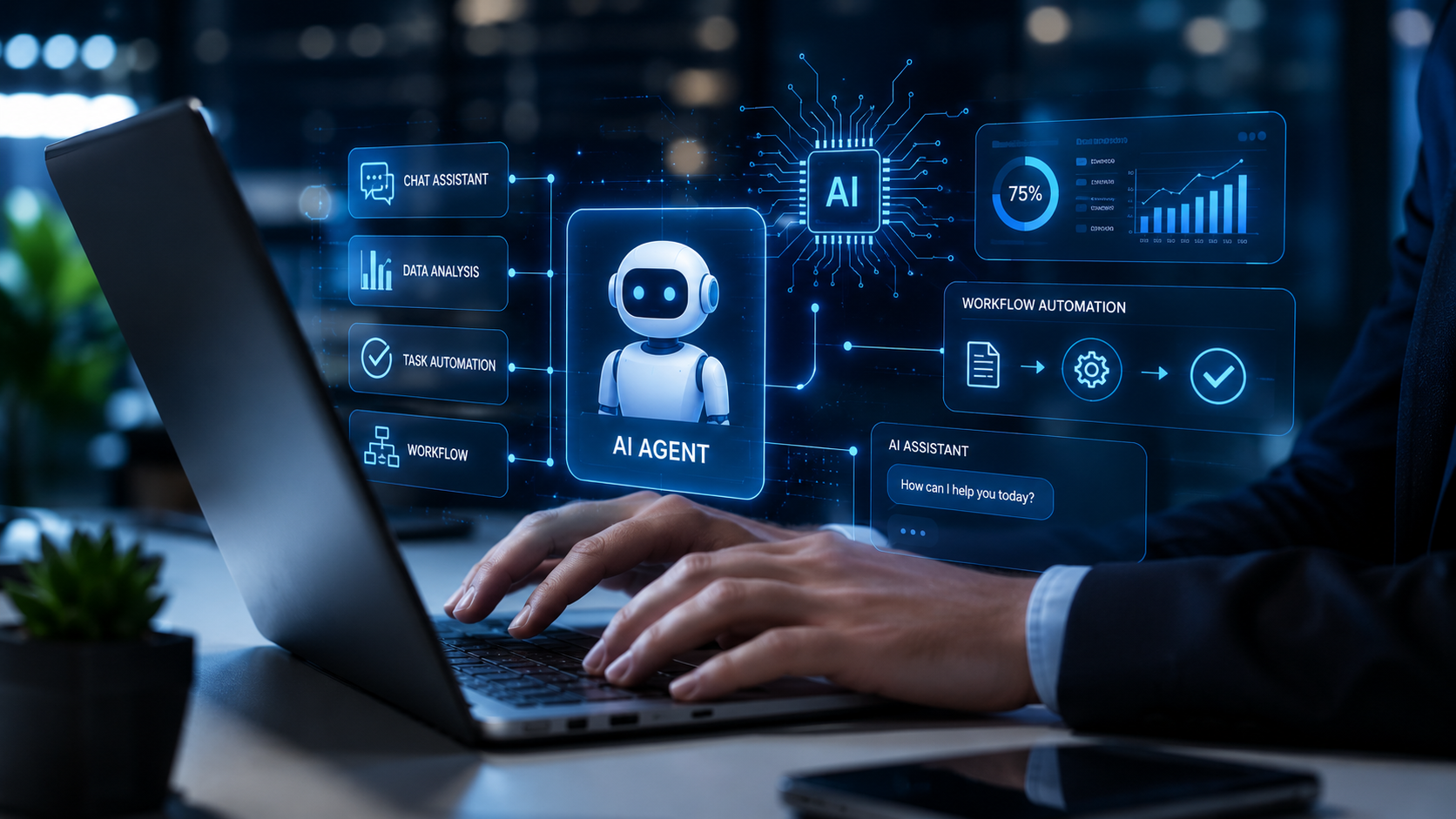
The next wave of AI deployment is not about better chatbots. It is about AI agents, systems that do not just respond to questions but autonomously plan and execute multi-step tasks, use tools, make decisions, and take actions in the world. The difference between a chatbot and an agent is the difference between an advisor and an employee. One tells you what to do. The other does it.
What Makes Something an Agent?
The term "agent" is overused in tech marketing, which makes it worth defining carefully. An AI agent has several characteristics that distinguish it from a conversational AI:
- 01Autonomy: An agent acts without requiring human input at every step. It receives a goal and pursues it.
- 02Tool use: An agent can use external tools, search engines, APIs, databases, code executors, file systems, to gather information and take action.
- 03Planning: An agent can break a complex goal into sub-tasks, sequence them logically, and adapt the plan when circumstances change.
- 04Memory: An agent can retain information across steps within a task (and in some architectures, across tasks) to build context and avoid repeating work.
- 05Action: An agent produces outputs that change the state of the world, a filed document, a sent email, an executed code change, a completed purchase, not just words on a screen.
The simplest way to think about it: a chatbot responds. An agent acts.
From Single Agents to Multi-Agent Systems
Early agent implementations were single-model loops: one model, given a goal and a set of tools, working through a task until completion. These work for moderately complex tasks but struggle with very long, very complex, or very specialised work.
The more powerful and increasingly common architecture is multi-agent systems: networks of specialised AI agents collaborating on a shared task, with an orchestrating agent coordinating their work.
Imagine a software development agent system:
- 01A planning agent breaks the feature request into components
- 02A coding agent writes the implementation
- 03A testing agent generates and runs tests
- 04A review agent checks for security issues and code quality
- 05A documentation agent writes the docs
- 06An orchestrating agent manages the workflow and resolves conflicts between agents
Each agent is specialised and operates within its domain. The orchestrator ensures the whole system works toward the goal. No single agent needs to be good at everything, the system's capability exceeds that of any individual component.
This architecture mirrors how human organisations work: specialised teams with defined responsibilities, coordinated by management toward shared goals.
What AI Agents Can Do Today
AI agents are already deployed in production across a range of domains:
Software development: Agents that take a GitHub issue, implement a fix, write tests, open a pull request, and respond to review comments, with minimal human involvement. Tools like Devin, SWE-agent, and frameworks like the Claude Agent SDK are pushing this frontier. Research and analysis: Agents that receive a research question, search the web, read papers, synthesise findings, and produce structured reports, automating work that previously took human analysts hours or days.
Customer operations: Agents that handle customer service enquiries end-to-end, not by retrieving pre-written answers but by understanding the problem, accessing backend systems, taking action (processing a refund, updating an account), and communicating the outcome.
Financial analysis: Agents that monitor markets, read filings, analyse portfolios, and generate recommendations, operating continuously and at a scale no human analyst can match.
Legal document processing: Agents that read contracts, extract key terms, flag issues, compare against templates, and generate redlines, compressing days of contract review into minutes.
Operational automation: Agents that manage IT systems, monitoring infrastructure, diagnosing incidents, executing remediation, and escalating when human judgement is required.
The Architecture of an Agent System
Building reliable AI agent systems requires attention to several architectural elements:
The model: The underlying LLM that drives reasoning and language understanding. Model choice affects capability, cost, and latency. Different agents in a system may use different models, a planning agent may need a powerful frontier model, while a documentation agent may function well with a smaller, faster, cheaper model.
The tools: External capabilities the agent can invoke, web search, code execution, database queries, API calls, file operations. Tool design is as important as model choice; poorly designed tools produce unreliable agent behaviour. The context window: What the agent can "see" at any given moment, its instructions, its memory, the current state of the task, tool results. Managing context effectively, deciding what to include and what to discard, is a significant engineering challenge for long-running agent tasks.
Memory systems: Short-term memory (within a session), long-term memory (across sessions), and semantic memory (a knowledge base the agent can query). Sophisticated agent systems combine all three.
The orchestration layer: The logic that coordinates multi-agent workflows, routing tasks to the right agent, handling failures, managing parallelism, and ensuring the overall task progresses toward completion.
Human-in-the-loop checkpoints: Where and how humans intervene in agent workflows. Even highly automated agent systems benefit from defined checkpoints where a human reviews progress, approves high-stakes actions, or resolves ambiguities the agent cannot handle.
The Hard Problems
Agent systems are powerful but introduce new categories of difficulty:
Reliability: Multi-step autonomous processes fail more often than single-step processes. Each step has some probability of error, and errors compound over long chains. Building reliable agents requires careful error handling, retry logic, and graceful degradation.
Observability: When a human makes a decision, you can ask them why. When an agent makes a decision, understanding the reasoning requires deliberate instrumentation, logging, tracing, and in some cases, asking the model to explain its reasoning explicitly. Without good observability, debugging agent failures is extremely difficult.
Safety and boundaries: Agents that can take action in the world can take harmful action in the world. Defining what an agent is and is not permitted to do, and enforcing those limits reliably, is a critical engineering and governance challenge. An agent that is too restricted is useless; one that is insufficiently restricted can cause significant harm.
Cost: Agentic workflows using frontier models make many model calls per task. At scale, the cost of running agents, particularly multi-agent systems, is significant and must be managed deliberately. Latency: Sequential agent tasks are slow. Multi-agent parallelism helps but introduces coordination complexity. For time-sensitive applications, agent architecture must be designed with latency budgets in mind.
The Business Implications
For organisations thinking about where AI creates strategic value, agent systems shift the calculus significantly.
The leverage point moves: Chatbots augment individual queries. Agents automate entire workflows. The leverage of agent deployment is much higher, but so is the implementation complexity and the risk if things go wrong.
The competitive moat deepens: An agent system that is integrated into your specific business processes, trained on your specific data, and tuned to your specific workflows is significantly harder to replicate than a generic chatbot. Agent infrastructure, built well, creates durable competitive advantage.
Human roles evolve: If agents can autonomously execute multi-step professional tasks, the roles of knowledge workers, analysts, developers, legal reviewers, operations staff, evolve from execution to oversight, curation, and exception handling. This is a significant workforce implication. New risks emerge: Agent systems that take real-world actions, sending communications, executing transactions, modifying systems, carry risks that purely conversational AI does not. Organisations need governance frameworks for what agents can do autonomously and what requires human approval.
Where to Start
For organisations considering their first agent deployments, a pragmatic approach:
- 01Identify high-value, well-defined workflows, Agent systems perform best when the task is clearly defined, the success criteria are measurable, and the
tools needed are accessible. Start with internal workflows rather than customerfacing ones.
- 01Build in human checkpoints, Do not deploy fully autonomous agents on consequential tasks on day one. Design workflows with human review at critical decision points, and progressively increase automation as confidence in the system grows.
- 02Invest in observability from the start, Logging, tracing, and evaluation infrastructure is not optional for agent systems. You cannot improve what you cannot observe.
- 03Think in workflows, not features, The value of agent systems comes from automating end-to-end processes, not individual steps. Design for the full workflow from the start.
At ASCENRA Technologies, we build on agent frameworks to create purpose-built automation for specific business domains, starting from the DPDP consent workflow and expanding across compliance, governance, and operational automation.
Note: This article is for informational purposes only. Technology capabilities described are evolving rapidly; specific tool capabilities may have changed since publication.